SES 2026 poster: overview and references
Bastien F. G. Aymon
PhD candidate in Mechanical Engineering
Massachusetts Institute of Technology
I study how mechanics at tissue–implant interfaces shapes the body’s response to implanted materials. My work combines materials design, mechanical analysis, and biological experiments to develop durable biointerfaces.
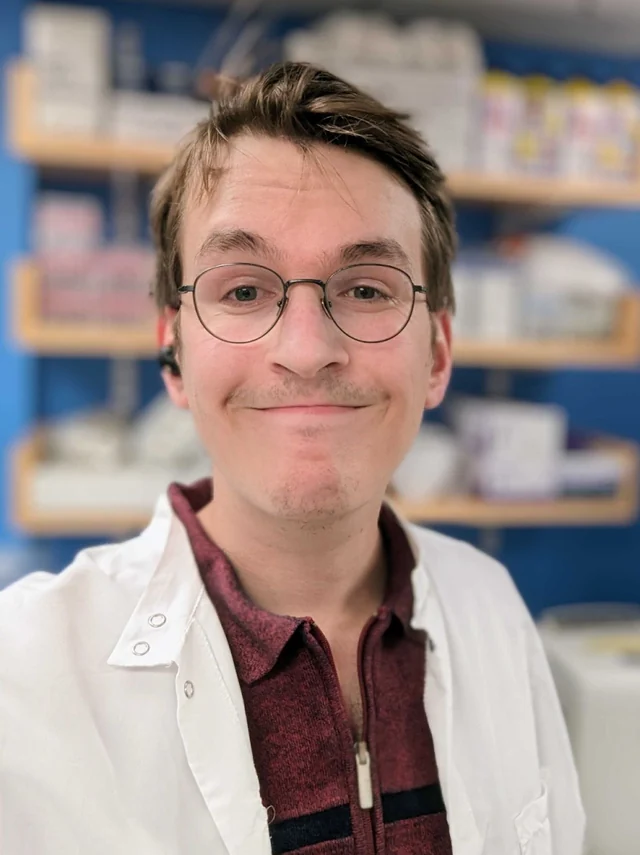
I joined MIT in September 2023 and am advised by Xuanhe Zhao. Before my PhD, I completed my BSc and MSc in Mechanical Engineering at EPFL, working on solid mechanics, computational modelling, and architected materials. That training now informs my experimental work in biomaterials.
Research
Adhesive biointerfaces
Current research
How do mechanical interactions at a tissue–implant interface shape the body’s response? I investigate this question through experimental biomaterials research, with the aim of making implanted interfaces more durable.
My experiments involve techniques such as material synthesis and characterization, cytotoxicity studies, rodent surgeries, histology, and downstream immunostaining and immunofluorescence.
Materials for biomedical devices
Biomaterials & collaboration
How can soft materials support useful devices while remaining compatible with living systems? My collaborative work includes hydrogels for gas exchange and adhesive hydrogel tendons for muscle-powered robots.
Architected materials & mechanics
Earlier work & continuing collaborations
How can geometry give materials useful mechanical properties? Building on my earlier training in solid and computational mechanics, I study how designed structures deform, dissipate energy, and fail.
My approach combines nonlinear mechanics modeling, finite element simulations, and precision experiments, with applications to slender and magnetic structures. One example is our study of the self-locking and stability of the bowline knot.
Science Advances · 2025
Adhesive electrodes maintained nonfibrotic nerve interfaces for up to 12 weeks and supported sustained neuromodulation in rat models.
Nature Communications · 2026
A geometric design framework makes the stiffness, stretchability, and failure patterns of three-dimensional woven lattices programmable.
Extreme Mechanics Letters · 2025
Experiments, simulations, and a friction-based model explain how a bowline locks and predict the conditions for its stability.
Nature Materials · 2025
Combining stiff trusses with compliant woven networks improves the balance of stiffness, stretchability, and energy dissipation in architected materials.
Leadership & teaching
Graduate student advocacy
MIT Graduate Student Council · External Affairs
- Chair 2026–present
- Vice Chair 2025–2026
- Communications and Public Outreach Co-Chair 2024–2025
As Chair, I lead the board’s work with federal, state, and local government. Our activities include drafting report language and meeting directly with state and federal lawmakers. The board’s priorities include research funding, STEM immigration, graduate mentorship, housing and infrastructure, and civic participation.
Research leadership & mentoring
MIT · Zhao Laboratory
- Bioadhesives subgroup lead Current
- UROP research supervisor 2024–present
I coordinate project directions and mentor students in the bioadhesives subgroup, spanning materials design, mechanobiology, and in vivo experiments. Through MIT’s UROP program, I have mentored four undergraduate researchers in experimental design, data analysis, and manuscript preparation.
Teaching in mechanics & computation
EPFL
- Teaching assistant 2019–2022
I supported courses in general physics, structural mechanics, slender structures, and machine learning through exercise sessions, tutoring, teaching materials, and assessment. I also supervised mechanical engineering bachelor projects.